Replies continued
WRBluenorcal · Jun 24, 2007#151 Originally Posted by
forpinks ↑ Also the 106HP (not high performance? I know.) is achieved using high grade high octane gasoline for testing (Since Japan don't have anything lower than 93 octane they even have 120-125 octane) the engine power will drop to 100flywheel HP when you use 87 gas and it will make more gunk to the engine because of the slight combustion difference even with the knock sensors, remember the 1NZ-FE is japan made and tested so It should run 90+octane and will get 51MPG elsewhere except US (may be possible with acetone) which don't have anything higher than 93 basic fuel 100 octane cost like 4.30 vs 3.30 91...
The rest of the world measures octane different than us in North America. In the EU and Australia, they advertise RON. Here we use an average of RON and MON. MON is a lower number than RON. YOU CAN'T COMPARE OCTANE RATINGS BETWEEN NORTH AMERICA AND THE REST OF THE WORLD.
The ignorance in this thread makes my head hurt.
Octane only measures the autoignition characteristics of gasoline. How easily it will explode without a spark.
THE ONLY THING THAT WILL CAUSE MPG TO INCREASE ARE O2 READINGS. If the O2 sensor reads the car running rich, it'll lean it out within safe parameters. Lean = less fuel used = higher MPG.
HIGHER OCTANE DOES NOT CHANGE THE AIR-FUEL MIXTURE. Higher octane gasoline can only prevent detonation. If your detonating with 87 octane, something is wrong with your engine/ECU.
A car runs a base timing and advances or retards it only within set parameters. And those parameters are ones set by Toyota Engineers as to be safe with low octane gasoline. The computer will not exceed those if you put high octane gas in and magically the computer knows.
Besides, there is no sensor that can tell what octane is used. To measure octane, you have to find out the percentage of volume is iso-octane and the percentage of volume is heptane. NO production car has the ability to do that...
And anyway, advancing timing does not cause less fuel to be used. It cause more power to be made from the fuel.
Everything else in this thread is anecdotal evidence. There are many, many, many variables. Elevation, wind, drag, tires, air pressure, surface type, load, weight, etc. The most important thing is repeatability. If you REALLY want to prove higher mileage, rent a couple weeks of dyno time in a lab. Control all the environmental variables to be constant for the whole week (temp, humidity, air flow, tire pressures). Empty the car 100% of all gasoline. put a predetermined mass of fuel in the car of a certain octane. Run about 40 tests and take the mean. IIRC 40 is the number where statistically each incremental test after that does not statistically significantly change the mean. Now change the octane and repeat all 40 tests.
Then and only then you can make assumptions if octane can change MPG.
Originally Posted by
WRBlue ↑
The ignorance in this thread makes my head hurt.
...a keyboard and a strong opinion make me an expert on this topic ;)
Originally Posted by
WRBlue ↑
Everything else in this thread is anecdotal evidence. There are many, many, many variables. Elevation, wind, drag, tires, air pressure, surface type, load, weight, etc. The most important thing is repeatability. If you REALLY want to prove higher mileage, rent a couple weeks of dyno time in a lab. Control all the environmental variables to be constant for the whole week (temp, humidity, air flow, tire pressures). Empty the car 100% of all gasoline. put a predetermined mass of fuel in the car of a certain octane. Run about 40 tests and take the mean. IIRC 40 is the number where statistically each incremental test after that does not statistically significantly change the mean. Now change the octane and repeat all 40 tests.
Then and only then you can make assumptions if octane can change MPG.
great idea for a test...but even if someone does perform a scientific experiment i, for one, am not willing to let the statistical facts get in the way of my own strong opinion (sarcasm intended!)
Originally Posted by
fu_im_from_texas ↑ 👏 ...toyota has spent 100s of 1000s of dollars looking at these issues. toyota says use 87 ... end of argument...
toyota has already performed these experiments....toyota recomends 87...
🤮
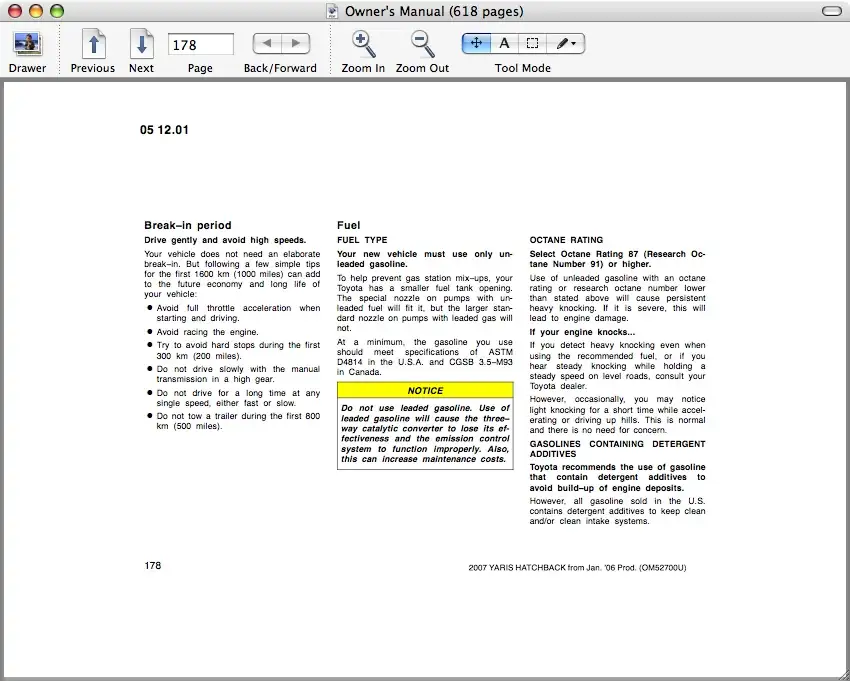
You must have a different owners manual, mine states:
SELECT OCTANE RATING 87 (RESEARCH OCTANE NUMBER 91) OR HIGHER.
This is page 178 in my owners manual. Obviously they know what a few of us are trying to pass on here!!!!!!!!!!!!!!! 👍
The tests have been done before higher octane was ever put on the market (probably the 30's). The ECU has taken the "must have" higher octane in your car away....but it hasn't removed the fact that performance and milage will improve in most engines with it. Note that I am not saying it is cheaper to put the higher octane in....but where I live it's very feasable (Iowa and South Dakota 89 octane is the same price or cheaper than 87, and in Minnesota I get 89 for 2 cents more than 87) and I use 89 octane.
blacksanVirginia · Jun 24, 2007#154jdiumHillsboro · Jun 24, 2007#155 Originally Posted by
churp ↑ The tests have been done before higher octane was ever put on the market (probably the 30's).
lol. Ya. Back when everything ran on leaded gas...
my head hurts...
Originally Posted by
jdium ↑ lol. Ya. Back when everything ran on leaded gas...
my head hurts...
Don't quite understand😕 Cars ran on unleaded in the US until 1970. I'm pretty sure sex was even invented by then!
No, I'm actually positive first hand, sex was invented before 1970.
Originally Posted by
churp ↑ Don't quite understand😕 Cars ran on unleaded in the US until 1970. I'm pretty sure sex was even invented by then!
No, I'm actually positive first hand, sex was invented before 1970.
Which brings me to my other point, don't smoke crack...🤷
Most every gas was LEADED (no UN) before 1970. Leaded gas has a realative octane rating of todays "race' gas, like 110 or something...
Originally Posted by
Pavel Olavich ↑ Your 'test' was not scientific....did you every consider that you could fill your tank up with 87 octane and drive your same route 10 times and get ten different MPG results? Your test lacks controls to be able to draw conclusions. Funny how you do your test once, and draw conclusions....did you attend college?
WOW. I just saw this.
Is this guy still here, or has he been banned?
1)
...did you every consider that you could fill your tank up with 87 octane and drive your same route 10 times and get ten different MPG results? Yes, and they are usually within .3-.5 MPG each time. I actually do the math and keep a log. That's as close to scientific as we can get.
2)
Your test lacks controls to be able to draw conclusions. As does your opinion.
3)
....did you attend college? Yes, Georgia Tech. I actually know the science- you
think you know the science. And don't try any cute comebacks- I'll just look at my degree and my paycheck and giggle.
Will there be anything else Pavel? I generally reserve arguing on the internet for times when I have nothing more adult to do, but watching you unravel and make a fool of yourself is worth it.
Unleaded gas didn't become common till the mid 80s. I remember when you had to hunt for the unleaded.
Leaded gas of the 70s was still 87 octane. Its just Lead is a knock detterant and so its a whole lot cheaper to make 87 octane with lead in it ;) . I'm not sure if the reason all the good race gas is leaded is cause its too expensive to make 110-120 octane without lead or if its actually impossible. You can get unleaded race gas up to about 100 or 102 octane...
cali yarisCanoga Park, CA · Jun 25, 2007#160{ OFF TOPIC }
As far as I know, sex was invented in 1976.
Uh... what was the topic about again?
(scrolling back to page one)
MooseCumming, GA · Jun 25, 2007#161 Originally Posted by
cali yaris ↑ { OFF TOPIC }
As far as I know, sex was invented in 1976.
Don't taunt the married animals. 🤣
Sorry, I just don't like mean people- usually mean and idiot go hand in hand, so it's that much more maddening.
I'm done, I promise.
Back on topic.
wow, my thread is going to start a war all over again.
churpTropical Minnesota · Jun 25, 2007#163 Originally Posted by
jdium ↑ Which brings me to my other point, don't smoke crack...🤷
Most every gas was LEADED (no UN) before 1970. Leaded gas has a realative octane rating of todays "race' gas, like 110 or something...
Wrong, read WRBlues post.
Thanks WRBlue for correcting me....1970 was when the compression ratio dropped in the US....along with performance.
well.. I filled up today, just for experimentation's sake, with 95 RON ethanol mix fuel. It's actually a good bit cheaper than 91.
Although, my methodology will be flawed, as I immediately took a (relatively) long drive. In my normal driving, I will see one bar drop after about 50-55km, but this is after a few days of short trips, after this one long trip (almost 100km), the bar dropped at around 80km into the tank. I drove at a steady 110-130km/h the whole way, as I had a passenger I could not really rev her up and see how the higher octane may affect the high RPM characteristics... I'll report more once I have better information to share 😁
YariiCanada · Jun 25, 2007#165They're not telling you to run higher octane... They're just putting the RON in brackets because the entire world except north america uses RON to measure octane. In NA our pumps are labled with the average of the RON and MON measurements, which is generally 4 or 5 points lower. 87 octane gasoline in north american is 91 RON.
Originally Posted by
churp ↑ You must have a different owners manual, mine states:
SELECT OCTANE RATING 87 (RESEARCH OCTANE NUMBER 91) OR HIGHER.
This is page 178 in my owners manual. Obviously they know what a few of us are trying to pass on here!!!!!!!!!!!!!!! 👍
The tests have been done before higher octane was ever put on the market (probably the 30's). The ECU has taken the "must have" higher octane in your car away....but it hasn't removed the fact that performance and milage will improve in most engines with it. Note that I am not saying it is cheaper to put the higher octane in....but where I live it's very feasable (Iowa and South Dakota 89 octane is the same price or cheaper than 87, and in Minnesota I get 89 for 2 cents more than 87) and I use 89 octane.
Originally Posted by
Moose ↑ WOW. I just saw this.
Is this guy still here, or has he been banned?
1) ...did you every consider that you could fill your tank up with 87 octane and drive your same route 10 times and get ten different MPG results?
Yes, and they are usually within .3-.5 MPG each time. I actually do the math and keep a log. That's as close to scientific as we can get.
2) Your test lacks controls to be able to draw conclusions.
As does your opinion.
3) ....did you attend college?
Yes, Georgia Tech. I actually know the science- you think you know the science. And don't try any cute comebacks- I'll just look at my degree and my paycheck and giggle.
Will there be anything else Pavel? I generally reserve arguing on the internet for times when I have nothing more adult to do, but watching you unravel and make a fool of yourself is worth it.
Your testing methods belie your "Georgia Tech" education. Sorry, but it was sloppy....by the way, I'm sure your giggling paycheck would make me laugh off my ass too!
Picture lost · jumi.lut.fi
Black YarisToledo, OH · Jun 25, 2007#168 Originally Posted by
WRBlue ↑ The rest of the world measures octane different than us in North America. In the EU and Australia, they advertise RON. Here we use an average of RON and MON. MON is a lower number than RON. YOU CAN'T COMPARE OCTANE RATINGS BETWEEN NORTH AMERICA AND THE REST OF THE WORLD.
The ignorance in this thread makes my head hurt.
Octane only measures the autoignition characteristics of gasoline. How easily it will explode without a spark.
THE ONLY THING THAT WILL CAUSE MPG TO INCREASE ARE O2 READINGS.
If the O2 sensor reads the car running rich, it'll lean it out within safe parameters. Lean = less fuel used = higher MPG.
HIGHER OCTANE DOES NOT CHANGE THE AIR-FUEL MIXTURE.
Higher octane gasoline can only prevent detonation. If your detonating with 87 octane, something is wrong with your engine/ECU.
A car runs a base timing and advances or retards it only within set parameters. And those parameters are ones set by Toyota Engineers as to be safe with low octane gasoline. The computer will not exceed those if you put high octane gas in and magically the computer knows.
Besides, there is no sensor that can tell what octane is used. To measure octane, you have to find out the percentage of volume is iso-octane and the percentage of volume is heptane. NO production car has the ability to do that...
And anyway, advancing timing does not cause less fuel to be used. It cause more power to be made from the fuel.
Everything else in this thread is anecdotal evidence. There are many, many, many variables. Elevation, wind, drag, tires, air pressure, surface type, load, weight, etc. The most important thing is repeatability. If you REALLY want to prove higher mileage, rent a couple weeks of dyno time in a lab. Control all the environmental variables to be constant for the whole week (temp, humidity, air flow, tire pressures). Empty the car 100% of all gasoline. put a predetermined mass of fuel in the car of a certain octane. Run about 40 tests and take the mean. IIRC 40 is the number where statistically each incremental test after that does not statistically significantly change the mean. Now change the octane and repeat all 40 tests.
Then and only then you can make assumptions if octane can change MPG.
so the higher octane combined with vvt-i will not change fuel econ?🙄
I ALWAYS get better mpg with premium fuel than 87... the only peple that deny the fact are the ones that have not tried it
Originally Posted by
Moose ↑ Picture lost · jumi.lut.fi
where did you find that picture of Pavel?
Originally Posted by
Black Yaris ↑ where did you find that picture of Pavel?
Same place I found this one...
Picture lost · www.mattymo.comdid you get ahold of his family photo's?
cleongSingapore · Jun 25, 2007#172I'm not taking sides, just relating personal experience.
Over here we have four grades of fuel at the service station, 92, 95, 98 and 98 Premium.
Each indicates a RON (which I understand to be different from the US). 98 Premium reputedly is the most "powerful" due to additional chemicals that boost power as well as clean up the engine (note that it is still listed as 98 RON).
Of the four, the only fuel that I have not sampled is RON 92. The other three I have tried, and found that 98 generally provides slightly better mileage than 95, although the price difference does not justify the mileage gained. 98 Premium is supposed to "burn" faster, therefore its mileage is actually poorer than regular 98 fuel. However it does seem to feel the most powerful of the three, having more eager throttle response and the engine sounding smoother.
WRBluenorcal · Jun 25, 2007#173 Originally Posted by
Black Yaris ↑ so the higher octane combined with vvt-i will not change fuel econ?
Yes. Why would it?
Originally Posted by
WRBlue ↑ Yes. Why would it?
Wouldn't a higher octane allow the engine to increase its timing and make more power, which means that less fuel is needed to maintain a given speed?
Engine's don't detect the octane of fuel... They just retard the timing if they detect knocking. Without doing some ECU tuning, the timing will always be set to or below (if knocking is present) whatever toyota engineers pre-programmed it to be based on engine and air conditions.
Premium might help keep the timing from retarding under high engine load like heavy acceleration or towing/hill climbing when knocking might occur, but for most daily driving, the engine will use the same timing settings it uses on regular gas.
Originally Posted by
cleong ↑ Wouldn't a higher octane allow the engine to increase its timing and make more power, which means that less fuel is needed to maintain a given speed?
So we should only run the absolute minimum RON recommended and anything above is just a waste of money?
churpTropical Minnesota · Jun 26, 2007#177No...it depends on how you drive. Lots of flat land and easy driving---87 octane. Lots of hills without slowing down and not creeping up them, and lots of fast starts----you may see a little better mileage with higher octane, but only during those higher load conditions. Each individual driver would have to judge for themselves if it would be a cost benefit....it's a slim one at best, but it may feel like a little more power in those conditions.
eTiMaGoBangkok, Thailand · Jun 26, 2007#178 Originally Posted by
cleong ↑ So we should only run the absolute minimum RON recommended and anything above is just a waste of money?
that seems to be the consensus...
I've just looked through all the ECU and ignition related stuff in the repair and technical manuals... my head's spinning now, our humble little car has some pretty advanced systems...
I was trying to find out if the ECU has any kind of learning system, that might try to advance the ignition timing until knock is detected, as this would allow it to run the maximum ignition advance regardless of the fuel used. But I find no evidence of this, but also no evidence of the contrary. From what I gather, the actual spark timing is determined by the crankshaft and camshaft position sensors, and retarded by the knock sensor when required.
What I did find out, though, is that the spark advance can be set in a range from -64 to +63.5 degrees, and the normal value when idling should be between 0 to 14 degrees.
Truthfully, the only way we can know for sure, is to have some device such as the Toyota intelligent tester used by the technicians, to monitor the actual ignition timing while driving with different tanks of fuel, such as 87, 91, 95 octane, and compare the average timing between each tank. Until then, it's really a matter of educated guesswork and subjectivity...
Originally Posted by
churp ↑ No...it depends on how you drive. Lots of flat land and easy driving---87 octane. Lots of hills without slowing down and not creeping up them, and lots of fast starts----you may see a little better mileage with higher octane, but only during those higher load conditions.
And only if your getting knock during thoes times. We drove up to Tahoe a couple months ago in the Yaris. It was slow, we did climb 8000 feet, but there was no knock and we got about 35MPG (higher than our average). Next time we're taking the WRX though ;)
Originally Posted by
WRBlue ↑ And only if your getting knock during thoes times. We drove up to Tahoe a couple months ago in the Yaris. It was slow, we did climb 8000 feet, but there was no knock and we got about 35MPG (higher than our average). Next time we're taking the WRX though ;)
You will not get a knock unless the ECU malfunctions....but it is guaranteed a 10.5 to 1 compression engine without knock sensors and ECU runs like crap on 87 octane. You would be able to get it to run level ground and very mild acceleration with good mileage,but you wouldn't want to drive up a hill. If you retarded the timing enough to be able to climb a hill the gas mileage would suffer big time. The ECU w/ knock sensors are wonderful items!! Premium would only add a little more power/efficiency on the climb IMO...definitely not enough to match the WRX!
Originally Posted by
eTiMaGo ↑ ... our humble little car has some pretty advanced systems...
+1
You dont get to design dynamic system controls at toyota without being very sharp. Toyota recommends 87 ...
Originally Posted by
fu_im_from_texas ↑ +1
You dont get to design dynamic system controls at toyota without being very sharp. Toyota recommends 87 ...
Toyota doesn't recommend 87.....they say: Select Octane Rating 87 or higher (read the owners manual, page 178, or other posts)...in the English language this means 87 is the lowest they allow. And yes they are very sharp.
Originally Posted by
churp ↑ Toyota doesn't recommend 87.....they say: Select Octane Rating 87 or higher (read the owners manual, page 178, or other posts)...in the English language this means 87 is the lowest they allow. And yes they are very sharp.
churp,
you are right. the "or higher" means that we should all run 110 octane race fuel ... i bet you will get 87 mpg and 200 hp ... your "understanding" of the english language is revolutionizing the yaris...
ok maybe it should say "87 or higher, within reason" 😁
YarisTom73Johnstown, PA · Jun 27, 2007#185Well, with all the 🙄 I can only draw the conlusion that we should do what we want with our own cars. If you don't like cheap gas, run something higher. If you don't like high octane, run cheap stuff. 'nuff crying about it, just split the difference and run mid-grade as I do 😳
fu_im_from_texasTexas · Jun 27, 2007#186 Originally Posted by
eTiMaGo ↑ ok maybe it should say "87 or higher, within reason" 😁
...also the "xx or higher" is the industry standard for recommending fuel. so my lexus gs430 says "93 or higher" which really doesnt make much sence, because 93 is the highest pump gas avaliable in north america... toyota is saying "use 93"
the yaris says "87 or higher" which really doesnt make much sence because you cant get anything lower than 87 in north america
...the industry standard is to recommend the octane then add "or higher" at the end
"....using a higher octane gasoline than your owner's manual recommends offers absolutely no benefit. It won't make your car perform better, go faster, get better mileage or run cleaner. Your best bet: listen to your owner's manual."
http://www.ftc.gov/bcp/conline/pubs/autos/octane.shtm why do people insist on ignoring empirical and statistical data?
🤮
i find the yaris timing is right on the border of you being able to use 87 octane. slight change of slopes and temp even with its ecu adjusting..gives you a sluggish feel...89 got better outcome..its could also be just my car.. "Dont you guys notice a whirring sound when you accelerate , try driving beside a wall" i need to know if this is normal. or a slight knockin on the engine?
eTiMaGoBangkok, Thailand · Jun 27, 2007#188 Originally Posted by
fu_im_from_texas ↑ ...also the "xx or higher" is the industry standard for recommending fuel. so my lexus gs430 says "93 or higher" which really doesnt make much sence, because 93 is the highest pump gas avaliable in north america... toyota is saying "use 93"
the yaris says "87 or higher" which really doesnt make much sence because you cant get anything lower than 87 in north america
...the industry standard is to recommend the octane then add "or higher" at the end
"....using a higher octane gasoline than your owner's manual recommends offers absolutely no benefit. It won't make your car perform better, go faster, get better mileage or run cleaner. Your best bet: listen to your owner's manual."
http://www.ftc.gov/bcp/conline/pubs/autos/octane.shtm why do people insist on ignoring empirical and statistical data?
🤮
Hmmm that's quite probable too, to be understood as, 87 is just fine, but don't worry if for some reason you can only get 91, it won't damage the engine.
heheheh too much science studies is just pushing me to experiment, if only I had that toyota intelligent tester or something similar to measure actual spark advance 🙁
Or, we can find a Toyota ECU engineer from Japan to enlighten us? 😁
Originally Posted by
marcus ↑ i find the yaris timing is right on the border of you being able to use 87 octane. slight change of slopes and temp even with its ecu adjusting..gives you a sluggish feel...89 got better outcome..its could also be just my car.. "Dont you guys notice a whirring sound when you accelerate , try driving beside a wall" i need to know if this is normal. or a slight knockin on the engine?
I wouldn't be knock, I pored through all I could find in the repair and technical manuals, as soon as the knock sensor feels something out of the ordinary, it will retard the spark, so unless there is something wrong with the knock sensor, you should not "feel" knock for over a second.
Originally Posted by
marcus ↑ i find the yaris timing is right on the border of you being able to use 87 octane. slight change of slopes and temp even with its ecu adjusting..gives you a sluggish feel...89 got better outcome..its could also be just my car.. "Dont you guys notice a whirring sound when you accelerate , try driving beside a wall" i need to know if this is normal. or a slight knockin on the engine?
Maybe if feels sluggish because it's only 105 hp going up a hill in hot weather? 😉
As for the whirring sound, it's probably exhaust noise. As quiet as these cars are, there is still some noise. It dissipates easily normally, but a wall would reflect it back to you...
thanks guys hopefully its nothing...
hystriaMontreal-Canada · Jun 28, 2007#192 Originally Posted by
cleong ↑ So we should only run the absolute minimum RON recommended and anything above is just a waste of money?
PROBABLY higher octane/RON will provide better fuel economy with this car... but the difference will be too minimal to be easily measured by just checking a mileage variation. YES, Toyota recommends using higher octane/RON for this engine in order to obtain better mixture burning, resulting in less polluting emanations. Buying 10-15% more expensive 89/91/94 gasoline won't result in 10-15% mileage increasing. Check out the black smut (?) on the exhaust when running on 87 octane, then whip it off and switch to 91 and check again.
Originally Posted by
hystria ↑ PROBABLY higher octane/RON will provide better fuel economy with this car... but the difference will be too minimal to be easily measured by just checking a mileage variation. YES, Toyota recommends using higher octane/RON for this engine in order to obtain better mixture burning, resulting in less polluting emanations. Buying 10-15% more expensive 89/91/94 gasoline won't result in 10-15% mileage increasing. Check out the black smut (?) on the exhaust when running on 87 octane, then whip it off and switch to 91 and check again.
"....using a higher octane gasoline than your owner's manual recommends offers absolutely no benefit. It won't make your car perform better, go faster, get better mileage or run cleaner. Your best bet: listen to your owner's manual."
http://www.ftc.gov/bcp/conline/pubs/autos/octane.shtm why do people insist on ignoring empirical and statistical data?
This is one of those discussions that just doesn't go away. I've seen the same thing on almost every non-premium fuel car forum I've seen. The signal to noise ratio tends to vary, but you've always got a couple people clinging to numbers and reports, a couple people clinging to their anecdotal evidence, and a couple people clinging to some hope that they can improve performance.
Just to add fuel to the fire, though, I don't think higher octane gas is going to do much of anything for you (nothing good, at least). Higher octane gas doesn't give you higher performance; it just resists pre-detonation. If you're at the point where the ECU is retarding timing due to pinging it'll keep you from losing performance. Unless the ECU is really designed for performance it isn't going to keep advancing the timing on it's own unless it's already retarded the timing (There are some that do do this. The WRX actually starts with a very conservative timing advance then ramps it up until it knocks, then pulls it back a little).
Higher octane gas CAN give you better mileage if the car can take advantage of it. Octane rating is basically a measurement of how long it takes fuel to burn. If the fuel burns longer you don't need to burn quite as much of it in the optimal case. You've got to get the ECU to realize that, though. If the ECU keeps the same ignition timing/AFR/whatever you're not going to see any benefit.
One thing I have seen with higher-octane fuel on a car factory-tuned for 87 is starting delay. From what I can tell (and this is coming almost entirely out of my ass, as this goes right past my league) since higher octane gas is more resistant to predetonation sometimes it's also a little too resistant to initial detonation. You try to start the car and the ECU finds the gas a little harder to light than it thought. Not a big deal at all, but at times an indicator that lower octane gas can actually run better than high-octane.
If you're looking for the best gas for your car just buy GOOD gas, not higher-octane gas. Go with a station that stocks gas with additives and detergents in it's 87. Chevron is a great example of this; they put their Techron additive in all the gas they sell. Once again, it's isn't going to add any more performance or gas mileage the car didn't have at one point. Maybe it'll keep it running a little cleaner, though, and it's my personal opinion that you're more likely to see a benefit from that than running high-octane gas.
KioshiFremont, CA · Jun 29, 2007#195 Originally Posted by
fu_im_from_texas ↑ ...also the "xx or higher" is the industry standard for recommending fuel. so my lexus gs430 says "93 or higher" which really doesnt make much sence, because 93 is the highest pump gas avaliable in north america... toyota is saying "use 93"
the yaris says "87 or higher" which really doesnt make much sence because you cant get anything lower than 87 in north america
...the industry standard is to recommend the octane then add "or higher" at the end
They say some number and higher because say if you are driving in a foreign country....than something higher than whatever number they tell you can be used. But who would spend the money to be driving a U.S. car in Europe or Africa anyway ~
Like Tom said, just use mid grade. If its used car use cheap stuff. If its a new car in your first hands, use mid grade. If its hp is 173+ use premium~
This topic always comes up on every forum that has to do with something that uses gas. It also turns into a huge debate taking up several pages and ending with the same result. The same goes for the big debate between using synthetic or natural oil.
hystriaMontreal-Canada · Jun 29, 2007#197 Originally Posted by
fu_im_from_texas ↑ "....using a higher octane gasoline than your owner's manual recommends offers absolutely no benefit.
TRUE. As per Yaris manual, it recommends 87 or higher. Why "
or higher" ? Ever wonder why Toyota recommends wasting your money ? With NO REASON ? Is Toyota in business with Shell ? Well, if not, there should be a reason, unless there are places on Earth that sell only 89 or higher octane gasoline... don't think so...
Engines are optimized to run with a precise level of octane. If an engine requires 87 and the owner put 89 or higher, there will be absolutely no benefit for the engine. On the other hand, if and engine is optimized to run with 89 and the owner uses 87, the engine will not run at 100% performance. It will knock more or little because the mixture ignites before the optimum moment during compression, thus leading to hot points on the piston/ring surface. Because the mixture ignites before the moment when the engine compression is optimal, it produces less overall performance. But not by much, one will not be able to feel any difference.
To resume... if using 87 the engine starts knocking, try changing the brand... the Yaris engine should not be knocking to an audible/damageable level while using good quality 87 octane gasoline.
Originally Posted by
Kioshi ↑ Like Tom said, just use mid grade. If its used car use cheap stuff. If its a new car in your first hands, use mid grade. If its hp is 173+ use premium~
That makes no sence...
If anything, an older car needs higher grade gas because of bad maintance, wrong plugs, carbon buildups in the combustion chamber, etc. But, if a car is maintaned, there is no reason what so ever to use anything but 87 octane. I have been to gas stations that don't sell less than 89, and I've been to some that sell 86...
There are a great many cars that make more than 170hp that only use regular. For example: My last truck was a V6 S10 that made 200-ish, and ran best on 86. The Jeep I traded in for the WRX made 235hp on 87.
ok there is stuff higher then 93 in north america its ether 94 or 95 from shell or sunoco
Kaotic LazagnaThread starterCentral Valley, CA · Jun 30, 2007#200wow, i can't stand to read this thread anymore, and it's my own thread. lol...
 Yarisworld