Information on HID Bulbs HID bulbs are... sensitive... compared to regular halogen bulbs. They require extra voltage to start up (ignite), and if you turn them off, you must let them "cool down" before turning them back on (30 seconds or so). This is because of the materials used in HID technology.
When you first turn HID lights on, extra voltage is applied to the bulbs (20,000-25,000 volts I think) to convert salts in the bulbs into xenon gas. This is why when you first turn on your HIDs you will see them change colors, starting blue or green, then eventually becoming pure white (or whatever color your bulbs are). The ballasts (the boxes that power HID bulbs) slowly turn down the power to the bulb, since it takes less electricity to keep the lights on once the startup/warmup process is complete.
When you turn the lights off, the voltage to the bulbs are cut off, and as the bulbs cool down the xenon gas slowly turns back into solid salts (takes about 30 seconds).
Now... If you flick your HIDs off and on, they will get pissed off at you and turn red/orange/pink. No joke. When you turn the lights back on, the ballasts feed the full 20,000+ volts into the bulbs even though the salt has already been converted into xenon gas. This damages the bulbs and significantly decreases their life span.
Why does this matter to you?
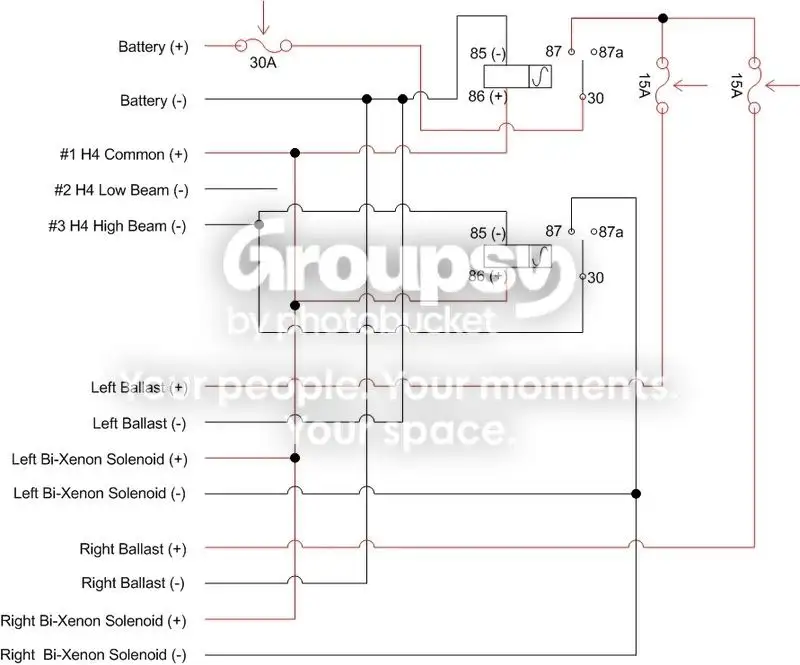
With your stock headlights, when you flash someone (or switch to high beams), your low beam turns off, and your high beam turns on. Duh, right? But what if we switch to HIDs? Now we've got a problem. We need to keep the low beam on AT THE SAME TIME that the high beam is on. Don't worry, we can solve this very easily when we begin wiring the HIDs.
Information on Wiring Harnesses Some people will tell you that you can power your HIDs off of the stock wiring 100% safely, and that they have been doing it for the last 10 years!!! Sounds great, right?
There are several reasons I refuse to take power from the stock headlight wires:
- The stock wire to the battery is only designed to power one filament at a time (either low or high). This is especially problematic with a kit like GabL has, where we will need to power the high beam bulb AND the low beam HIDs SIMULTANEOUSLY.
- HID ballasts pull a lot of current to fire up the bulb (as I explained earlier). Who knows if the stock wiring is designed to handle this extra draw? Do you want to find out by risking a car fire?
What really happens most of the time is people try to use the stock wires for power, but find the HIDs only go "click click click click" and flicker on off on off (which is bad for the bulb as I have already explained). This is because the HID ballast starts to ignite the bulb, but runs out of juice due to the restrictive stock wiring. It tries this over and over again, which slowly kills both itself and the bulb. Some people don't have this problem, but to me, it just isn't worth the risk of losing my whole car.
The Solution If we use the stock headlight wires to trigger a relay (a special type of switch), we can avoid all these problems. The relay will connect the HID ballasts/bulbs to the battery/ground, using our own wires chosen for this specific purpose.
I'll add more background info as we need it. Now that we know what to do, let's get started. (I'm working on post/part 3 now)
-----------------------------------
fyi, the foglight bulbs appear to be positive switched, while the relay that switches the foglights are negative switched. Confused yet? lol.. Unfortunately, I think the fog lamps turn off when the high beams are turned on, so you cannot simply wire the + and - wires of the fog lights to trigger your relay. The solution is similar to how we will wire GabL's low beam.
 Yarisworld