mf4361Original postSK · Mar 25, 2013#1I am trying to change out my spark plug, as mine has 126000km on it and its still the same one out from factory.
I was trying to unscrew it by a crappy (Canadian) tire spark plug remover (very low quality), but i can't get it loose even by forcing it. Obviously I don't want to really force it out as its possible that it seized up. My next step is to break it loose by a ratchet/socket (and so I got a 6" extension bar). My question is, how hard should I try undoing it before I take it to a garage for a proper seized-up plugs removal?
Sorry if its a stupid question, I am really new to DIY vehicle maintenance.
Thanks all!
Replies 20
junorico24Sydney · Mar 25, 2013#2It's important to use the right tool.A ratchet with an extension plus a spark plug remover socket. Turn it anti clockwise/ counter clockwise until the plugs loosens up. I would say a firm turn on the ratchet should do the job..
WARNING!! disconnect your negative battery terminal first just in case.
bronsinnj · Mar 25, 2013#3Not removing the sparkplugs for a long time can lead to their seizing for various reasons. A brown residue will build up on the threads. If that is the cause forcing the plug out will PROBABLY not take the threads with it. 🙂
On the other hand....
If the threads in the head come out with the plugs you are SCREWED! I would wait for people to check in here whether or not the head will have to come off to repair them. 😢
If not...then you just have to have the car towed to a mechanic and pay $$$ to fix it. 😢
With electronic ignition and fuel injection sparkplug life is practically indefinate. If you chose to leave the plug in there Im thinking thats a good choice if you plan to keep the car only a couple more years.
You could put the plugs back in, take it to a mechanic and innocently ask to have the plugs changed. If he strips it its his dime.
Or he could just pretend he did it...
My advice:
Put the other plugs back in and drive it. 👍
Take it to a mechanic.
Good luck and tell us what happens!
cali yarisCanoga Park, CA · Mar 25, 2013#4 I was trying to unscrew it by a crappy (Canadian) tire spark plug remover (very low quality),
That is a bad strategy. Use GOOD tools, and have an extension on hand. My plugs "break free" when I take them out. After that first pop, they come out easy.
If you're having that much trouble getting one out, it would be way better to have a professional do it for reasons mentioned above. The plug can break. This is why mechanics recommend pulling them every 60k or because they like to weld themselves to the head.
alanwagenTexas · Mar 25, 2013#6The engine has to be cold cold cold as with thermal expansion, the heads will hold the plugs when they are warm.
edmscanCanada · Mar 26, 2013#7I had the same problem with my 87 Accord. I couldn't get the plugs out .. and I bent the Canadian Tire spark plug removal tool as well (yes it does really suck). I actually had the mechanic at Canadian Tire remove / reinstall my spark plugs for me. They did it for free ... must have been a good day as really I pretty much hate Canadian Tire.
I sold the Accord to an auto wrecker a week later (this is when I bought my Yaris). Not my problem now.
bronsinnj · Mar 26, 2013#8 Originally Posted by
alanwagen ↑ The engine has to be cold cold cold as with thermal expansion, the heads will hold the plugs when they are warm.
I have removed stuck plugs by removing them with the engine HOT after trying it COLD. 😲
Cold is the default for plug removal. 🙂
But sometimes you try it different. 👍
Thanks for all the advice! I will try next time when I have time.
bronsinnj · Mar 27, 2013#10 Originally Posted by
mf4361 ↑ Thanks for all the advice! I will try next time when I have time.
When you try it with a beefier socket arrangement try it with the engine cold first.
If it wont budge warm the engine up and try it.
Ive had time to rethink my advice on this. I suspect you just have a stuck plug that will come out okay once you put the beef to it.
But I wont be able to sleep until I hear what happens! 😁
Ok :D standard practice first. lucky here in my town is still about 4 degree above zero so its still rather cold for a spark plug change
YaristeveLos Angeles · Mar 27, 2013#12I had to google this "crappy (Canadian) tire spark plug remover" to see what you guys are talking about. Throw it away!
Get a good spark plug socket for your ratchet. Although you can use a standard socket (save $$$), spark plug sockets come with a little rubber donut insert to help you from cracking the insulator when installing a new plug. Plus the donut helps hold the spark plug in the socket as you lowering it into the spark plug well; that way your plug won't fall in and possible change the gap.
esse10richmond TX. · Mar 27, 2013#13If you only replace the plugs once every 100k miles than yea it would be a good Idea to remove them around 50k miles , put anti-seize compound on the threads, check the gap and re-install. You'll have no problem taking them loose the next time at 100k miles.
bronsinnj · Mar 27, 2013#14Here is a quick tutorial for removing spark plugs from the Yaris (and ECHO and many others) Obviously meant for people who havnt done this before.
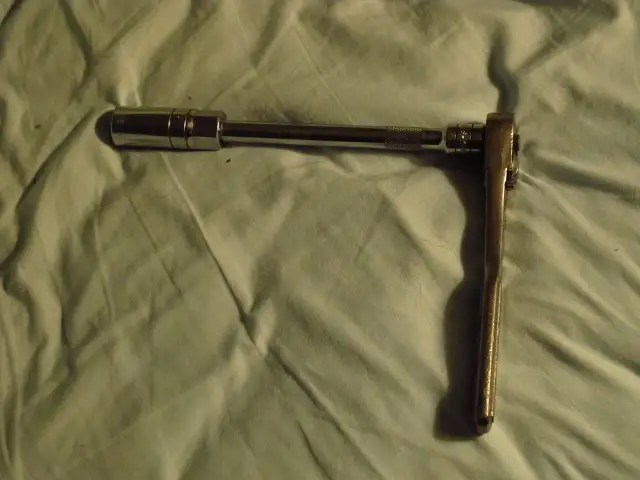
The picture is the tool you want. A 3/8 inch drive ratchet, a six inch extension in 3/8 inch drive and a 5/8 inch sparkplug socket also 3/8 inch drive.
The six inch extension is Shoo Gooed to the sparkplug socket. It is NOT shoo glued to the ratchet! The socket cant be removed from the extension making it a tool to remove sparkplugs only.
The 5/8 sparkplug socket has a rubber insert to hold the sparkplug while you unscrew and lift out the origional plug and to hold the replacement plug while you lower it in place.
The six inch extension is shoo glued to the socket to prevent the socket from pulling off the extension when removing it from the new sparkplug.
When installing the new sparkplug (or reinstalling the old one) spray the rubber insert with WD40. This will allow the insert to hold the plug while lowering it into place and allows to plug to easily slip out of the socket once it is screwed and torqued into the head.
The reason for the shoo goo and WD40 is the extension will pull off the socket and stay down in the cylinder head when installling the new plug and tryiong to get the tool out of the hole.
Any Questions? 🤷
another thing that works pretty good is using black electrical tape to keep the socket attached to the extension and also you can use some tape at the end of the socket to temporarily hold the new spark plug in the socket as you put it back in the hole. Just lower it down slow and get a few threads started then pull out the extension & socket, then move the end tape out of the way and use the same socket/extension & ratchet & regularly tighten plug snug tight. then you can torque as required. I can post a picture of this if anybody wishes, I have been doing that method on all my cars for years now. 👍 Don't use the socket that has the rubber o-ring inside used to remove the spark plug because sometimes that rubber o-ring comes off and stays stuck deep in the hole and now you would be doing wasted work trying to fish that out of the hole. & I don't like putting wd40 on my new plugs either, just regular dialectric grease to keep moisture away.
mf4361Thread starterSK · Mar 29, 2013#16I finally got a chance this afternoon to change the plugs out. I used a 5/8" spark plug socket, 6" extension and a ratchet. It took a little more force than I expected to get it out. (So first thought is it might have seized up) But as suggested above a firm turn on the ratchet break it loose and it got out easily.
The old plugs are actually still in pretty good shape after 126000km (and they drove well) but its good preventive maintenance so I don't get stranded on the roadside when the time comes
After installing the new plugs, engine starts better, the starter clicks 2-3 times and it starts (compared to 4-5 clicks before). I don't see a big improvement in Performance/economy. However, Idle seems to be quieter and at high rev (>4500) it definitely sounded smoother.
Thanks for all your help and advice!!
https://www.dropbox.com/s/uyvsib1ctv...329_164906.jpgAwesome glad you endevoured to persevere and you had no trouble! 🤘
junorico24Sydney · Mar 30, 2013#18 Originally Posted by
mf4361 ↑ I finally got a chance this afternoon to change the plugs out. I used a 5/8" spark plug socket, 6" extension and a ratchet. It took a little more force than I expected to get it out. (So first thought is it might have seized up) But as suggested above a firm turn on the ratchet break it loose and it got out easily.
The old plugs are actually still in pretty good shape after 126000km (and they drove well) but its good preventive maintenance so I don't get stranded on the roadside when the time comes
After installing the new plugs, engine starts better, the starter clicks 2-3 times and it starts (compared to 4-5 clicks before). I don't see a big improvement in Performance/economy. However, Idle seems to be quieter and at high rev (>4500) it definitely sounded smoother.
Thanks for all your help and advice!!
https://www.dropbox.com/s/uyvsib1ctv...329_164906.jpg
Next is to change the transmission fluid and that would improve your shifting and ride a bit.
Get yourself a long clear tube and a bottle. Cut the bottle in half, drill a hole on the cap of the bottle put the clear hose through it. This is to get the fluid into your tranny hole.
NEXT undo the fill plug first, very important.Then the bottom drain plug is next.
By the way do it on a level area. Let the fluid drip out onto a catch pan, after it empties completely put the plug back on snug. Then fill it up by using your DIY half bottle with a clear tube.Slide this apparatus into the fill hole.
Then all you have to do is get 2 quarts of synthetic manual transmission fluid.Pour it into the bottle this will go down onto the clear tube and into the fill hole.Fill it up until it drips out. Let it level out then put the fill plug back on and torque it snug.
One more important tip - apply some anti-seize on the plug treads to ensure easy removal the next time.
mf4361Thread starterSK · Mar 30, 2013#20 Originally Posted by
junorico24 ↑ Next is to change the transmission fluid and that would improve your shifting and ride a bit.
Get yourself a long clear tube and a bottle. Cut the bottle in half, drill a hole on the cap of the bottle put the clear hose through it. This is to get the fluid into your tranny hole.
NEXT undo the fill plug first, very important.Then the bottom drain plug is next.
By the way do it on a level area. Let the fluid drip out onto a catch pan, after it empties completely put the plug back on snug. Then fill it up by using your DIY half bottle with a clear tube.Slide this apparatus into the fill hole.
Then all you have to do is get 2 quarts of synthetic manual transmission fluid.Pour it into the bottle this will go down onto the clear tube and into the fill hole.Fill it up until it drips out. Let it level out then put the fill plug back on and torque it snug.
Good DIY write up. But the car had a transmission fluid change about 30000km ago (just before I owned it) so I guess it'll last longer than that.
Btw, mine has a AT gearbox.
Originally Posted by
alfredyeez ↑ One more important tip - apply some anti-seize on the plug treads to ensure easy removal the next time.
Reading from NGK tech bulletin:
http://www.ngksparkplugs.com/pdf/tb-...1antisieze.pdf they suggests that applying anti-seize on plugs with chrome-plated thread will cause mistakenly overtightened plugs. I have the NKG IX plugs and the threads are shiny so I think that applies to me.
Yes that can happen if you use a torque wrench. Torque values are for DRY threads. 🙂
Also antiseize has been known to short plugs out. 😲
 Yarisworld