touroxinOriginal postCalifornia · Oct 30, 2008#1The goal is to jack my Yaris up so I can rotate all four tires at once.
I have four 3-ton jack stands, Harbor Freight Model 38846
One 2-ton low profile racing jack, Harbor Freight Model 92782
The jack stands minimum height in 11-3/4 inches
The max lifting range of the jack is 18-1/4 inches
and a 2008 Yaris.
The problem is that when I jack up the car from the rear I can not get the driver's side of the car high enough to place my jack stand. I can on the passenger side if I take off my protective rubber pad, which I'd rather not do if I don't have to. As you probably know, the rear jack point is off center that is why the passenger side is higher than the driver's side.
What are you guys using to jack up your Yaris?
I have not even tried jacking up the front of the car. I think I know where the jack point is from looking at the 2007 service manual, but I'm not sure exactly where the front jack point is.
Any help would be great! Thanks in advance.
- Touroxin
Replies 61
jkuchtaL.A. · Oct 30, 2008#2I use the center front jacking point to get the front end up, then I jack up the back just forward of the rear-sidesill jacking points on each side. There is very little weight in the rear of the car(at least in my HB😉) so the wear and tear on the side sill is very low.
b_hickman11Tyler, TX · Oct 30, 2008#3 Originally Posted by
touroxin ↑ The goal is to jack my Yaris up so I can rotate all four tires at once.
I have four 3-ton jack stands, Harbor Freight Model 38846
One 2-ton low profile racing jack, Harbor Freight Model 92782
The jack stands minimum height in 11-3/4 inches
The max lifting range of the jack is 18-1/4 inches
and a 2008 Yaris.
The problem is that when I jack up the car from the rear I can not get the driver's side of the car high enough to place my jack stand. I can on the passenger side if I take off my protective rubber pad, which I'd rather not do if I don't have to. As you probably know, the rear jack point is off center that is why the passenger side is higher than the driver's side.
What are you guys using to jack up your Yaris?
I have not even tried jacking up the front of the car. I think I know where the jack point is from looking at the 2007 service manual, but I'm not sure exactly where the front jack point is.
Any help would be great! Thanks in advance.
- Touroxin
I jack up the back of my Yaris and put a jack stand on each side. Then I jack up one of the front sides, do a tire change. Then I jack up the other front side and do another change. So LF goes to LR, LR to RF, RF to RR, and RR to LF. Takes about 10 minutes to do the whole job.
Originally Posted by
b_hickman11 ↑ So LF goes to LR, LR to RF, RF to RR, and RR to LF. Takes about 10 minutes to do the whole job.
Correct me if I am wrong but dosen't the Owners Maunal suggest LF to LR, LR to LF, RF to RR and RR to RF. Using this method I only have to jack up one side of the car at a time.
Originally Posted by
nemelek ↑ Correct me if I am wrong but dosen't the Owners Maunal suggest LF to LR, LR to LF, RF to RR and RR to RF. Using this method I only have to jack up one side of the car at a time.
No it doesnt.....The way you mentioned is for rear wheel drive vehicles, which are usually trucks. The way I mentioned is what is recommended by the tire manual for front wheel drive vehicles like the Yaris.
My Papa says it is not good to rotate tires so - now I have one less thing to forget about. Some thing about the " carcass set" 🤷
TheSilkySmoothNew Hampshire · Oct 31, 2008#7My brother says WHAT IS THIS "carcass set"?
is that The Dead Girl's Boobs?
😲
sick boy🤮
touroxinThread starterCalifornia · Oct 31, 2008#8jkuchta I think you are right. I was thinking about this last night.
If I jack up the front of the car first I should be able to get the jack stands in place.
I should then be able to jack up the back of the car high enough to put the second set of jack stands in place.
I'll find out on Saturday!
Thanks everyone!
floydisrockPhoenix Arizona · Oct 31, 2008#9I always rotate my tires back to front as the fronts wear faster.
I would never jack up all four corners of a unibody car.
Even though the car is light,stressing the whole unibody is not something I'm willing to attempt.
touroxinThread starterCalifornia · Oct 31, 2008#10I do plan on rotating my tires as per my 2008 US manual that reads "back to front" so you are right floydisrock, I only need to jack up one side at a time.
After I prove to myself that one can jack the car up and set it on four jack stands, I'll probably only jack up one side at a time!
nemelekArizona · Oct 31, 2008#11 Originally Posted by
b_hickman11 ↑ No it doesnt.....The way you mentioned is for rear wheel drive vehicles, which are usually trucks. The way I mentioned is what is recommended by the tire manual for front wheel drive vehicles like the Yaris.
Page 252 of my 2008 Yaris Hatchback Owners Manual has a rotation diagram of what I stated previously. Maybe the sedan's manual shows a different rotation pattern. On my old 88 Toyota 4X4 and 04 Dodge Ram 4X4 the rotation suggests crossing the left and right sides.
Originally Posted by
b_hickman11 ↑ No it doesnt.....The way you mentioned is for rear wheel drive vehicles, which are usually trucks. The way I mentioned is what is recommended by the tire manual for front wheel drive vehicles like the Yaris.
hmmm He's correct according to my 08 liftback manual.
just rotat front to rear, and rear to front.
I did rotations at 5k, then 9k, and am now at 18k and have skipped the last two rotations because tread wear is so similar it makes no difference. I actually still have slightly more tread on my fronts than rears. Go figure.
Originally Posted by
nemelek ↑ Page 252 of my 2008 Yaris Hatchback Owners Manual has a rotation diagram of what I stated previously. Maybe the sedan's manual shows a different rotation pattern. On my old 88 Toyota 4X4 and 04 Dodge Ram 4X4 the rotation suggests crossing the left and right sides.
Toyota makes cars and Bridgestone makes tires. Dont follow Toyota's manual. You need to look at your tire manual. It says "Tire Maintenance, Safety and Warranty Manual" on the front of it. Refer to page 6. I am attaching a copy of this page but it might not work......
Guys, it all comes down to the tread. If you have a tread pattern that requires that the tire rotate in a certain direction you then have to do back to front.
Can someone post a good picture of what the front jack point looks like?
I think I know where the jack point is from looking at the 2007 service manual, but I'm not sure exactly where the front jack point is.
nemelekArizona · Nov 1, 2008#15 Originally Posted by
b_hickman11 ↑ Toyota makes cars and Bridgestone makes tires. Dont follow Toyota's manual. You need to look at your tire manual. It says "Tire Maintenance, Safety and Warranty Manual" on the front of it. Refer to page 6. I am attaching a copy of this page but it might not work......
Thanks for proving my point!
On page 6 of the Bridgestone Tire Safety and Warranty Manual it clearly states "For maximum mileage, rotate your tires according to the
vehicle manufacture's recommendations (consult your vehicle owner's manual)."
I'll use the Bridgestone's recommendation to use the Yaris Owner's Manual guidelines on tire rotation. This will save me time and effort by only having to jack up one side of the car at a time.
In the long run, it probably doesn't matter which rotation pattern is used. What matters is that it is done in a timely and consistant manor.
Good luck in getting miles out of the Bridgestones. I look at mine and they are worn out at 15 thousand miles. I dont kniow how bad the guy drive befor me - he was old guy so I think not too badly. My Papa said you could delaminate the cap if you rortate back to front on a car that has big diffrence in "camber" betwixt axles fore and aft. This is well known in racing circles.
b_hickman11Tyler, TX · Nov 1, 2008#17Same here. I rotated mine every 5000 miles and they were bald at 25,000. And I drive like a grandpa. Too bad the mileage warranty is void on our cars....
talnlnkySpokane, Wa · Nov 1, 2008#18 Originally Posted by
b_hickman11 ↑ Same here. I rotated mine every 5000 miles and they were bald at 25,000. And I drive like a grandpa. Too bad the mileage warranty is void on our cars....
thats weird, I'm nearing 19k, and i've still got a decent amount of tread. What PSI's did you run, and what are your driving habbits? Mostly city? or Highway? if highway, how fast? 50pmh/60mph/70/ 80????
i drive 70% highway and 60-65 while on the highway. I try to reduce the amount of times i have to start & stop as much as possible... I figure stopping & starting is probably more wear on your tires as well as less mpg's when I fill up.
90% highway, 70 mph, 32 psi on my 07. So far the ones on my 08 are wearing fine. Maybe they just had a bad crop in 07??
b_hickman11Tyler, TX · Nov 1, 2008#20 Originally Posted by
nemelek ↑ Thanks for proving my point!
On page 6 of the Bridgestone Tire Safety and Warranty Manual it clearly states "For maximum mileage, rotate your tires according to the vehicle manufacture's recommendations (consult your vehicle owner's manual)."
I'll use the Bridgestone's recommendation to use the Yaris Owner's Manual guidelines on tire rotation. This will save me time and effort by only having to jack up one side of the car at a time.
In the long run, it probably doesn't matter which rotation pattern is used. What matters is that it is done in a timely and consistant manor.
The Toyota owners manual also says that you should not over inflate your tires by their recommendations which is 32 psi. It states that over inflating will cause poor handling, excessive wear, etc. So you go by your Tire company for psi but you go by Toyota for rotation guidelines?? You think that Toyota's psi ratings are a joke and that the tire company's rotation guidelines are a joke?? Sounds like you don't know who to follow or maybe you are believing every thing you see on the net?
Originally Posted by
TheSilkySmooth ↑ My Papa says it is not good to rotate tires so - now I have one less thing to forget about. Some thing about the " carcass set" 🤷
You are right. No need to rotate them unless they are wearing unevenly or the fronts are so worn out that you want to give rears a chance to catch up.
Tire rotation is an old thing when cars had horrible alignment issues and had to have tires rotated. These days it's just a way for service technicians to earn a living... just like 3,000 mile oil change.
Front tires turn....rear tires do not....this causes a different wear pattern on the front and rear tires. This is why you rotate, but I guess the multi-billion dollar tires companies dont know what they are talking about.....
touroxinThread starterCalifornia · Nov 2, 2008#23Well, I rotated my tires this weekend, back to front, jacking up one side of the car at a time. The difference in tread wear was obvious. I have 5,200 miles on the car.
I've always rotated the tires on my cars so they wear evenly. When the time comes for new tires I always buy four new tires and the process starts again.
For those keeping track, I am now 97% sure where the front jack point is located. Does anyone have a nice picture of it??
IsLNdbOiLas Vegas, NV · Nov 2, 2008#24Anyone use ramps instead of jacks?
nemelekArizona · Nov 3, 2008#25 Originally Posted by
b_hickman11 ↑ So you go by your Tire company for psi but you go by Toyota for rotation guidelines?? You think that Toyota's psi ratings are a joke and that the tire company's rotation guidelines are a joke?? Sounds like you don't know who to follow or maybe you are believing every thing you see on the net?
I have never seen a psi recommendation by a tire company. Anybody who has put any thought behind this would understand why. The tire company doesn't know what kind of car the tires are going on. FWD, RWD, AWD, 4WD?? They don't know the weight or the weight distribution of the vehicle. Therefore they leave the proper inflation up to the manufacture. For example on my 08 Yaris running stock Bridgestone 185 60R 15 the small print on the tire says "Follow owners manual or tire plagard in vehicle -- Inflate to recommended pressure -- Never exceed 40 psi." So the tire company has suggested that the user follow both the rotation and inflation guidelines set by the manufacture. I trust Toyota engineering and do things the way the owners manual states. The real injustice to the "net" is that people without reading the owners manual are able to state personal opinions as fact.
On a side note. I don't care what psi people are using. However, I have been involved in 2 personl injury lawsuits involving lawyers and insurance companies. I wouldn't put anything past either of them. If you are driving with over inflated tires and posting your psi on the internet and get into an accident caused by a blow out, the insurance company or lawyer will find a way to use that information against you.
Originally Posted by
IsLNdbOi ↑ Anyone use ramps instead of jacks?
wouldn't the wheels then be sitting on the ramps instead of the floor? Or was this a joke and I just didn't catch the tone?
I was just stating that he was following the tire manufactor's max rating of 44 psi and saying Toyota's recommendations where a joke. He also said that the tire manufactors rotation guidelines where a joke and that he followed Toyota's. So therefore he is follow the tire manufactors guidelines for one thing but following Toyota's for another.....
IsLNdbOiLas Vegas, NV · Nov 3, 2008#28 Originally Posted by
PaidTimeOff ↑ wouldn't the wheels then be sitting on the ramps instead of the floor? Or was this a joke and I just didn't catch the tone?
I meant using ramps to work on stuff under the car.
Originally Posted by
IsLNdbOi ↑ I meant using ramps to work on stuff under the car.
Haha ok, guess I got sidetracked on the whole rotating tires stuff.
I used ramps to install my exhaust on the car, but I couldn't use ramps to get under the front because my car's dropped and the ramps are just a bit too steep.
Originally Posted by
john21031 ↑ You are right. No need to rotate them unless they are wearing unevenly or the fronts are so worn out that you want to give rears a chance to catch up.
Tire rotation is an old thing when cars had horrible alignment issues and had to have tires rotated. These days it's just a way for service technicians to earn a living... just like 3,000 mile oil change.
You are spreading complete lies.
Tire rotation on today's cars is a must and the ONLY way to squeeze out the most milage from tires. It is as relevent today as it was 100 years ago. Surely you're not so ignorant to realize that the front tires will wear two or more times faster then the rear, yea?!?
I run the original Bridgestone tires that came on the 2007 Yaris Hatchback, and I over inflate to 50 PSI, and get this: I'm at 48,000 miles and can easily reach 50,000 and still have thread left.
So how and why you guys are getting sheet milage from your Bridgestones is beyound me...it must be your lack of good driving habits and lack of tire rotation.
The proper way to rotate radial tires is front to back, back to front. Only the old bias ply tires switched sides of the car....never do this with today's radials....
Originally Posted by
nemelek ↑ I have never seen a psi recommendation by a tire company. Anybody who has put any thought behind this would understand why. The tire company doesn't know what kind of car the tires are going on. FWD, RWD, AWD, 4WD?? They don't know the weight or the weight distribution of the vehicle. Therefore they leave the proper inflation up to the manufacture. For example on my 08 Yaris running stock Bridgestone 185 60R 14 the small print on the tire says "Follow owners manual or tire plagard in vehicle -- Inflate to recommended pressure -- Never exceed 40 psi." So the tire company has suggested that the user follow both the rotation and inflation guidelines set by the manufacture. I trust Toyota engineering and do things the way the owners manual states. The real injustice to the "net" is that people without reading the owners manual are able to state personal opinions as fact.
On a side note. I don't care what psi people are using. However, I have been involved in 2 personl injury lawsuits involving lawyers and insurance companies. I wouldn't put anything past either of them. If you are driving with over inflated tires and posting your psi on the internet and get into an accident caused by a blow out, the insurance company or lawyer will find a way to use that information against you.
ALL tire companies do IN FACT recommand a PSI setting for their tires. Surely you're not that stu---....nevermind.
Guess where Toyota gets the recommanded PSI from?
The. Tire. Company.
In addition, it does not matter if the car is 4x4 or what it weighs because the amount of air needed to put a tire to a particular PSI differs according to the weight of the vehicle. So our Yars, for example needs less air in the tires for 35PSI then if the car weighted say 500 lbs more. In other words, all you have to do is add enough air to bring the PSI to the proper level...
Originally Posted by
SilverGlow ↑ You are spreading complete lies.
The proper way to rotate radial tires is front to back, back to front. Only the old bias ply tires switched sides of the car....never do this with today's radials....
So you're saying that cross rotation will hurt our tires?
Originally Posted by
b_hickman11 ↑ So you're saying that cross rotation will hurt our tires?
Yes, cross rotation will mean faster and uneven wear.
Talk to any tire tech and they will tell you that radials must stay on the same side of the car.
Switching sides when rotation worked great years ago when tires were bias ply. But nobody makes bias ply for passenger cars anymore.
Originally Posted by
SilverGlow ↑ ALL tire companies do IN FACT recommand a PSI setting for their tires. Surely you're not that stu---....nevermind.
Guess where Toyota gets the recommanded PSI from?
The. Tire. Company.
In addition, it does not matter if the car is 4x4 or what it weighs because the amount of air needed to put a tire to a particular PSI differs according to the weight of the vehicle. So our Yars, for example needs less air in the tires for 35PSI then if the car weighted say 500 lbs more. In other words, all you have to do is add enough air to bring the PSI to the proper level...
I will bet you $100 that you can't find any proof where Bridgestone recommended to Toyota to put 32 PSI in their 185 60R 15 tires for the Yaris.
There is probably an industry guidelines for tire type and sizes. The amount of load on a tire and the corresponding the PSI are in those guidelines. It's Toyota's responsibility to pick a correct tire and recommend the proper PSI.
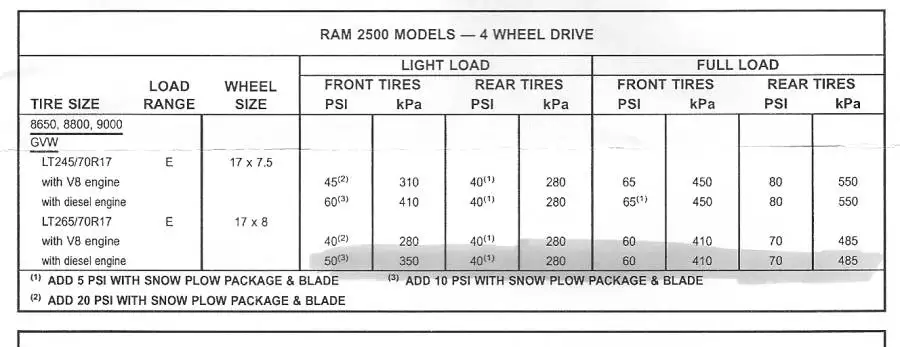
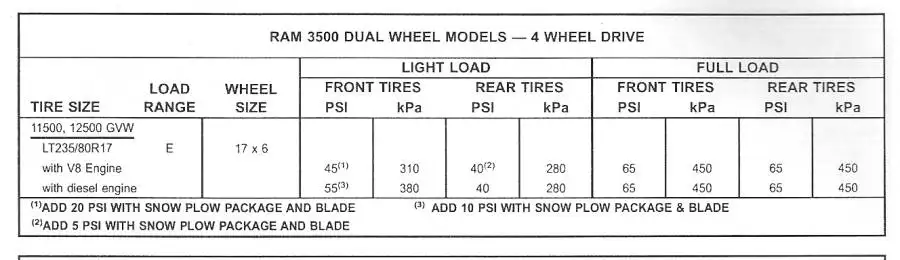
The weight of a vehicle does matter. If the Yaris was a 1,000 pounds heavier or lighter their might be a different tire or PSI recommendation. On the chart below for the Dodge Ram you will note that the front tires for a light load with the diesel require 10 to 15 PSI more than the V-8. Why? Because the diesel weighs a lot more. Notice when the truck goes from light load to heavy load the PSI for the rear tires go from 40 to 70 or 80. Why? Because as the weight increases there is an additional need to increase the PSI. There are some idiots that would put 120 PSI in the rears. Do you really think that "The.Tire.Company." made this chart for Dodge? More likely Dodge engineers figured the load for the tires in different situations and used the tire guidelines from the manufactures put together this chart.
Originally Posted by
SilverGlow ↑ recommanded
I may be stu--- but at least I can spell recommended.
Originally Posted by
nemelek ↑ I will bet you $100 that you can't find any proof where Bridgestone recommended to Toyota to put 32 PSI in their 185 60R 14 tires for the Yaris.
There is probably an industry guidelines for tire type and sizes. The amount of load on a tire and the corresponding the PSI are in those guidelines. It's Toyota's responsibility to pick a correct tire and recommend the proper PSI.
The weight of a vehicle does matter. If the Yaris was a 1,000 pounds heavier or lighter their might be a different tire or PSI recommendation. On the chart below for the Dodge Ram you will note that the front tires for a light load with the diesel require 10 to 15 PSI more than the V-8. Why? Because the diesel weighs a lot more. Notice when the truck goes from light load to heavy load the PSI for the rear tires go from 40 to 70 or 80. Why? Because as the weight increases there is an additional need to increase the PSI. There are some idiots that would put 120 PSI in the rears. Do you really think that "The.Tire.Company." made this chart for Dodge? More likely Dodge engineers figured the load for the tires in different situations and used the tire guidelines from the manufactures put together this chart.
This chart is for a 6 wheel Dodge rather than a 4 wheel Dodge, correct?
how do I jack up my yaris? I work at a auto repair shop...so...chassis lift on the toyota reccomended lift points....muahahahahah.
as far as tires...i wouldnt ever over inflate a cheap OEM equipment radial...thats just me though. I have worked at dealerships before and I have seen the results of over and under inflating said cheap tires. most tires wear evenly at 5-10 pounds under max pressure rating.
nemelekArizona · Nov 5, 2008#38 Originally Posted by
b_hickman11 ↑ This chart is for a 6 wheel Dodge rather than a 4 wheel Dodge, correct?
No. This chart is the Dual (6 tire) 1 ton 4X4.
The last post was for a 2004 3/4 ton 4X4 which weighs 7,000 pounds. I think the 1 ton is 500 pounds heavier.
Originally Posted by
Spades ↑ how do I jack up my yaris? I work at a auto repair shop...so...chassis lift on the toyota reccomended lift points....muahahahahah.
as far as tires...i wouldnt ever over inflate a cheap OEM equipment radial...thats just me though. I have worked at dealerships before and I have seen the results of over and under inflating said cheap tires. most tires wear evenly at 5-10 pounds under max pressure rating.
Nice!
Yeah, boy that would be helpful!
Anyone who has a digital camera, a Yaris (HB or Sedan), and knowledge of the jack points... Please post a picture of said jack points so Voodoo22 and I can verify the jack points on our cars??
Thanks fellow Yaris owners!!!
ozmddDFW, TX · Nov 7, 2008#41I can tell you two facts about tire rotation wear from personal experience and some engineering research:
FWD vehicles suffer significantly more wear to the front tires than the rear for three reasons: engine/tranny weight, steering wear, acceleration/braking wear (depends on the driver). Rotation will definitely aid in equalizing this wear between the 4 tires.
Modern steel belted radials shold only rotate in one direction, and do risk delamination/belt twisting when run on the opposite side of the vehicle, though the risk varies greatly depending on vehicle type, tire sidewall height and inflation pressure. Often the tire will not fail, but the lateral belts can become "curved" in the original rotation direction, and then resist flex in that direction when reversed. On larger tires (33" on my Jeep) this can result in a noticeable wave in the tread. Also, I have seen tires blow-out after being installed (used) without knowing the original rotation, although that could have been caused by a number of other factors too.
Bottom line: Rotate your tires regularly if you prefer to replace all 4 at once and want to get the maximum mileage from your tires. don't rotate at all if you don't mind replacing 2 at a time or don't care if 2 of your tires still have more tread left when you replace them.
NEVER cross-rotate modern radial tires, directional or not. :)
b_hickman11Tyler, TX · Nov 7, 2008#42 Originally Posted by
ozmdd ↑ I can tell you two facts about tire rotation wear from personal experience and some engineering research:
FWD vehicles suffer significantly more wear to the front tires than the rear for three reasons: engine/tranny weight, steering wear, acceleration/braking wear (depends on the driver). Rotation will definitely aid in equalizing this wear between the 4 tires.
Modern steel belted radials shold only rotate in one direction, and do risk delamination/belt twisting when run on the opposite side of the vehicle, though the risk varies greatly depending on vehicle type, tire sidewall height and inflation pressure. Often the tire will not fail, but the lateral belts can become "curved" in the original rotation direction, and then resist flex in that direction when reversed. On larger tires (33" on my Jeep) this can result in a noticeable wave in the tread. Also, I have seen tires blow-out after being installed (used) without knowing the original rotation, although that could have been caused by a number of other factors too.
Bottom line: Rotate your tires regularly if you prefer to replace all 4 at once and want to get the maximum mileage from your tires. don't rotate at all if you don't mind replacing 2 at a time or don't care if 2 of your tires still have more tread left when you replace them.
NEVER cross-rotate modern radial tires, directional or not. :)
So it sounds like you are saying that tires have a mind of their own....or maybe even a computer chip that tells what side of the car it should be on??
Originally Posted by
touroxin ↑ Yeah, boy that would be helpful!
Anyone who has a digital camera, a Yaris (HB or Sedan), and knowledge of the jack points... Please post a picture of said jack points so Voodoo22 and I can verify the jack points on our cars??
Thanks fellow Yaris owners!!!
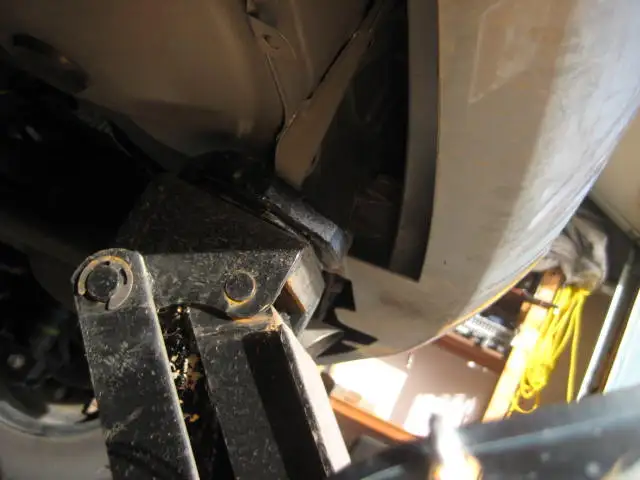
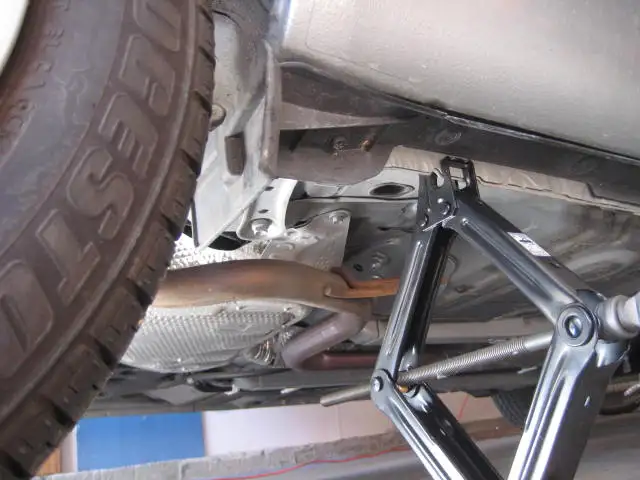
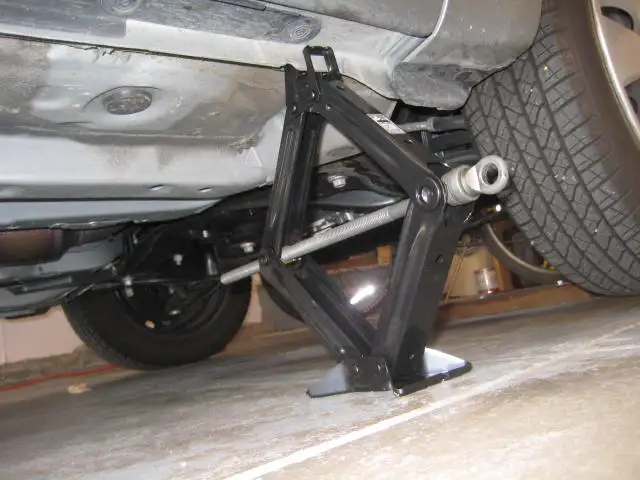
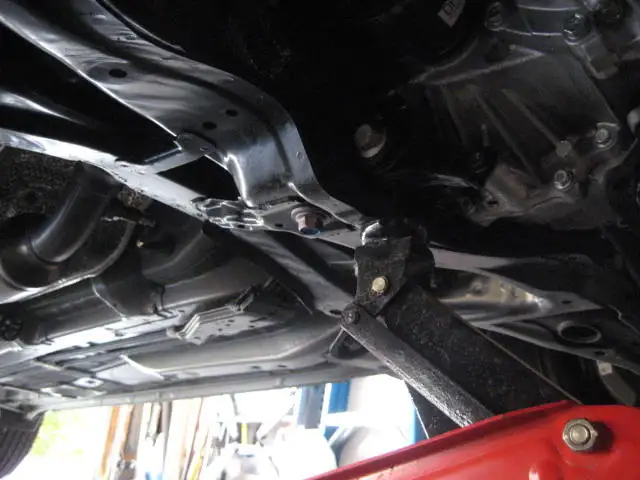
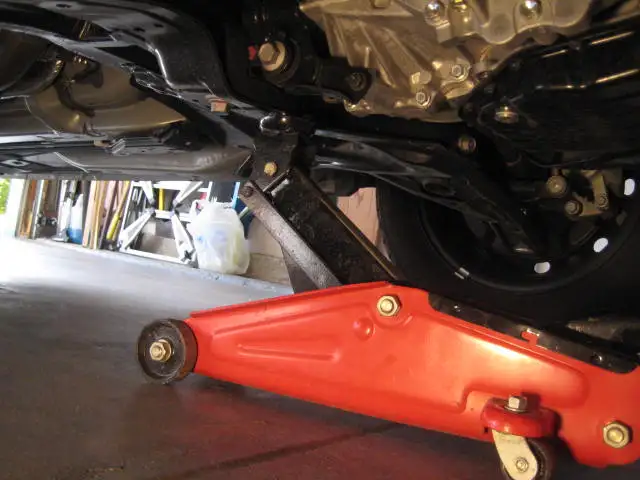
The rear jack up point is 4 inches in front of the license plate. 1st picture using a 3 ton floor jack.
The side jack up points are between V notches close to the front and rear tires. 2nd and 3rd picture using the car jack. The cheapest car jack I have ever used.
The front jack up point is about 32 inches from the front bumper using a 2 ton floor jack. The 3 ton jack was hard to fit under the car. Remember to use parking brake when jacking up the front.
When I rotate tires I'll use the 2 & 3 ton jacks on one side of the car at a time. I don't think that I'll ever have the need to jack up the front or rear tires at the same time. These pictures are from a 2008 hatchback.
Great!!!
Thanks!!!!!
touroxinThread starterCalifornia · Nov 9, 2008#45I think the Sedan is the same, it is just that the rear jack point is in the middle instead of more to the passenger side.
PenquinZ111US · Dec 27, 2008#46i use a lift. since i do work a at dealership
thebarberGrand Rapids, MI · Dec 27, 2008#47i just use the side jack point closer to the front of the car (behind the front wheel) and jack it all the way up....i do one side at a time for rotation.....
so rear passenger --> front passenger and front passenger --> to rear passenger then i do the same for the drivers side...
this way i only have to jack up once per side and it works whether you have direction tires or not....
justlknCanada · Nov 14, 2010#48 Originally Posted by
PenquinZ111 ↑ i use a lift. since i do work a at dealership
Just installed winter tires on the Yaris, using a trunk jack.. I have a lift in my shop, but really hate lifting vehicles with no frame.. Pickup trucks are easy.. what would one use for lift points on a yaris.
^ same as the jack points. My car has been on a lift more times than I can remember. If you don't want to mess up that lip underneath, insert a slotted block to preserve it.
N3misiSSouth Africa · Nov 15, 2010#50WHy dont you ask for help at a tire place and put the car on the lift, my dealer does it free...
It saves a lot of frustration....
its quicker.
 Yarisworld